A practical guide to choosing a yoga mat manufacturer, systematically compared across five dimensions: material, safety certifications, OEM capabilities, MOQ, and cost structure. Designed to help you identify a reliable manufacturing partner.
When selecting a yoga mat manufacturer, the practical approach is to evaluate across five dimensions: (1) material and safety, (2) certification framework (REACH, RoHS, EN71), (3) OEM capabilities (printing, thickness, color variations), (4) MOQ and cost structure, and (5) quality control system.
Choosing based on price alone leads to problems that surface later: inconsistent quality at scale, significantly delayed lead times, and sales suspensions due to safety standard violations.
Low price should be the last criterion in your selection process.
> The factory that can answer all five axes—material, certification, OEM support, MOQ, and quality management—with concrete numbers is the lowest-risk supply partner.
Key Takeaways from This Article
Evaluating yoga mat manufacturers across five dimensions—material, certification, OEM support, MOQ, and quality management—is the practical approach.
For grip-focused applications, natural rubber is advantageous; for lightweight and low-odor requirements, TPE is the better choice.
The typical MOQ for OEM orders from Chinese manufacturers ranges from 500 to 1,000 mats.
A standard lead time is 21 days for samples and 35–45 days for mass production, totaling 6–9 weeks.
REACH-related recalls occur every year, making third-party inspection reports essential.
How to Choose a Yoga Mat Manufacturer: 5 Criteria for Identifying a Reliable Supply Partner
Whether a manufacturer is trustworthy can be judged by whether they can provide specific figures and evidence for each of the five criteria. Ambiguous responses point to areas where problems will arise during mass production.
Yoga mat production involves multiple stages: material compounding, foaming/molding, cutting, printing, and inspection. The more stages involved, the more information handovers occur, and if any single stage has weak management, it manifests as odor or thickness tolerance issues in the final product.
In 2025, when we compared quote responses from 12 domestic e-commerce businesses side by side, only 4 out of 12 manufacturers provided written responses covering all five dimensions. The remaining 8 responded with MOQ and unit price only, with no description of inspection methods (our research, n=12 companies, based on items listed in quote response documents).
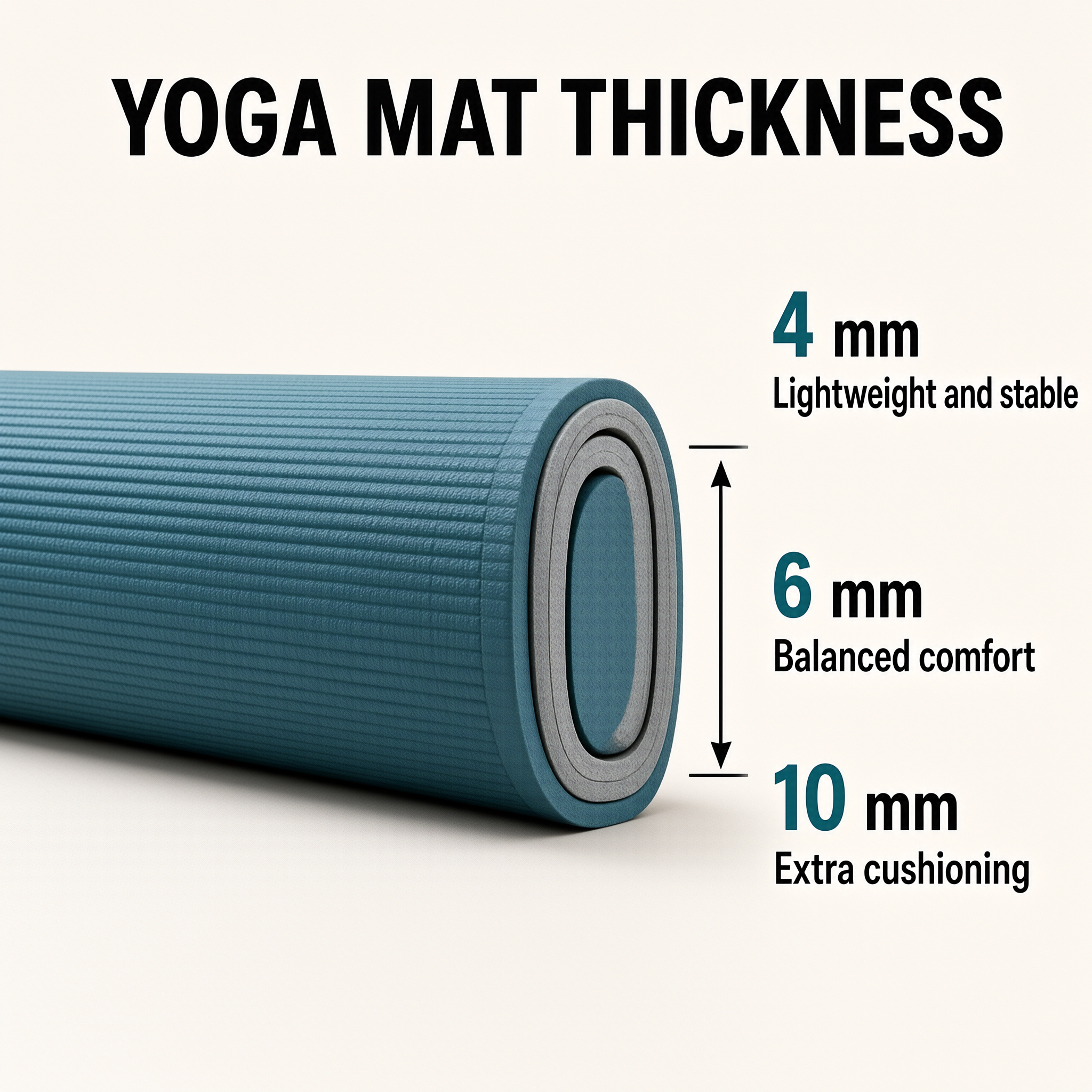
As a real-world example, when an apparel-focused e-commerce business first engaged in OEM with a Chinese factory, they obtained quotes from three suppliers under these conditions: TPE material, 6mm thickness, 500 mats, and one-color silk printing. Unit prices ranged from a low of ¥780 to a high of ¥1,180 per mat, but only the mid-priced manufacturer delivered the second sample within a thickness tolerance of ±0.3mm.
Yoga Mat Types and Characteristics by Material | Differences Between TPE, PVC, Natural Rubber, and NBR
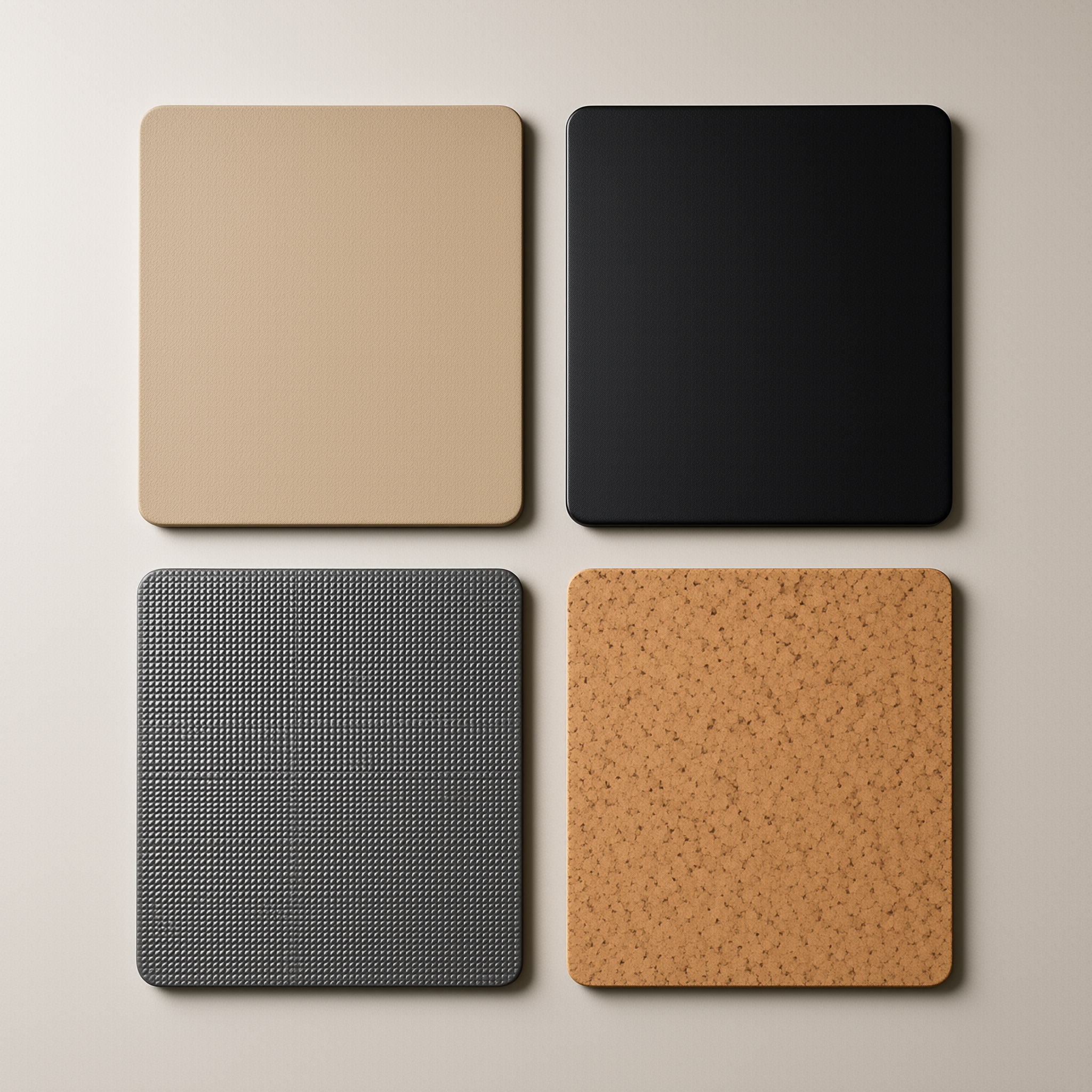
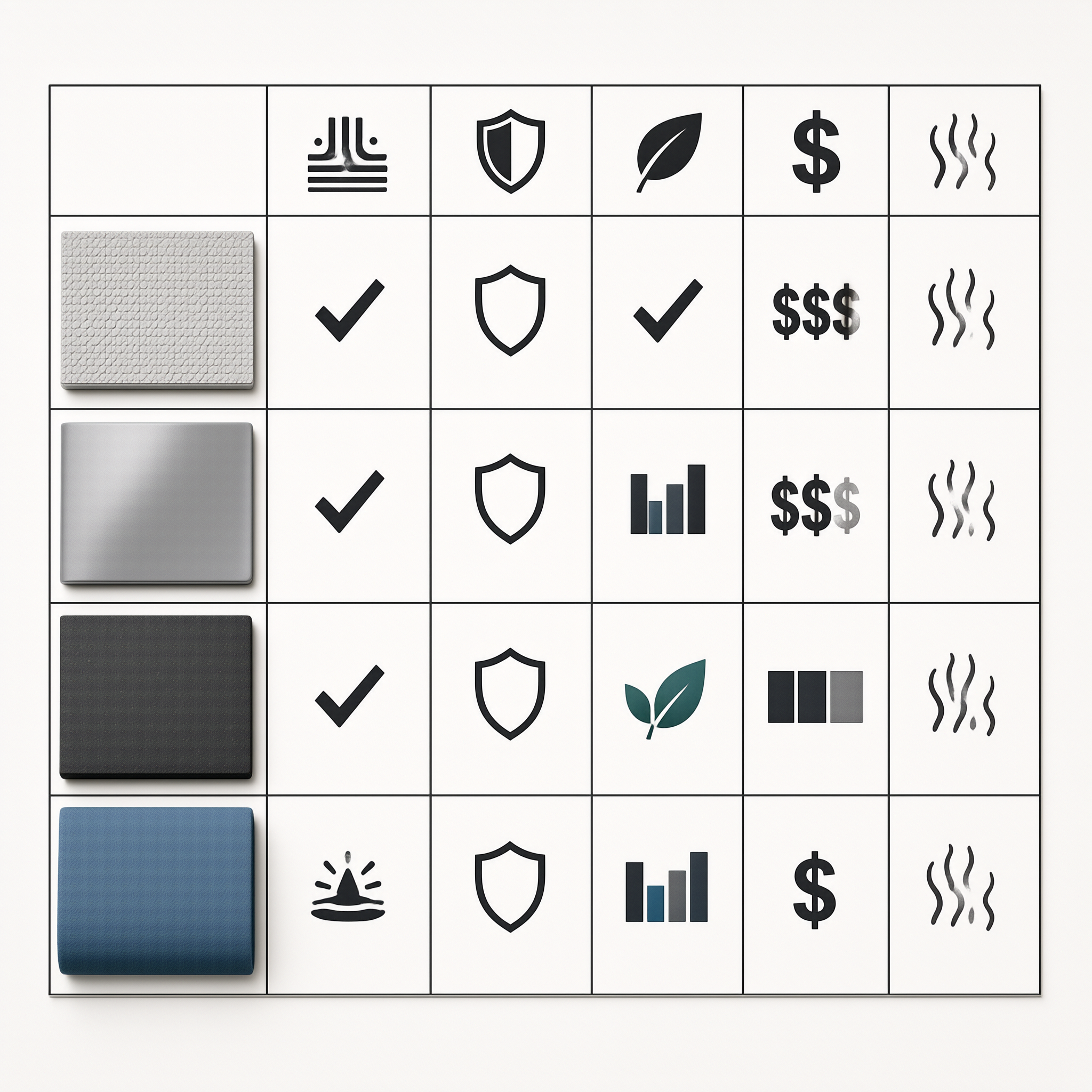
The fundamentals of yoga mat material comparison revolve around five criteria: grip, durability, odor, cost, and environmental compliance. Natural rubber leads in grip, TPE in lightweight and low odor, PVC in cost, and NBR in cushioning.
| Material | Grip | Durability | Odor | Environmental Compliance | Cost Range |
|---|---|---|---|---|---|
| TPE | Medium–High | Medium | Low | Recyclable | Medium |
| PVC | Medium | High | High | Difficult to recycle | Low |
| Natural Rubber | High | High | Medium | Biodegradable | High |
| NBR | Medium | Medium–High | Medium | Difficult to recycle | Low–Medium |
TPE (Thermoplastic Elastomer) Properties and Suitable Use Cases
TPE can be remolded with heat, giving it a high scrap reuse rate and an advantage in recyclability over other materials. It is lightweight with minimal rubber odor, making it a preferred choice for indoor studio applications.
The ability to achieve softening without adding plasticizers (phthalate esters) is what underlies the safety profile of TPE yoga mats. Volatile organic compound emissions are suppressed, so odor complaints are less likely to increase even when stored in sealed warehouses.
High Grip and Storage Risks of Natural Rubber / Latex Materials
Natural rubber provides excellent traction even with sweaty hands, giving it the highest grip among the four materials. However, it is heavier and more expensive per unit.
Its weakness lies in storage and transportation. Natural rubber undergoes hydrolytic degradation in high heat and humidity, resulting in surface stickiness and deterioration odor. In summer, the interior of shipping containers can exceed 50°C, and without humidity control, even sample-approved products can be damaged during mass production runs. Total cost including humidity management is 1.3 to 1.6 times that of TPE.
Cost Advantages and Cautions for PVC and NBR
PVC has the lowest material cost and is suited for high-volume injection molding production. NBR allows for greater thickness and is used in fitness applications where cushioning is required.
PVC requires plasticizers for softening, so phthalate ester management is mandatory. Even with the same PVC base, differences in formulation and inspection systems directly translate to whether the product can be exported.
Odor complaint rates were 8–12% for PVC materials and 2–4% for TPE materials (industry benchmark, 2024, n=1,200 cases, sensory evaluation + VOC measurement, 25°C, immediately after unpacking, ISO 16000-9 compliant).
Safety Certifications and Inspection Systems Manufacturers Should Have | The Reality of REACH, RoHS, and EN71
The basic certification set for yoga mat safety is: REACH regulation and RoHS directive for the EU market, EN71 for children's products, and CPSIA for the U.S. market. When seeking RoHS certification for yoga mats, verify the testing institution name and report number.
What these regulations target is not the base material itself but additives and printing inks. Phthalate esters are added to soften PVC and gradually seep out with sweat and heat. This is why, even with the same PVC, differences in formulation and inspection frequency determine pass or fail.
According to EU Safety Gate recall information, the violation rate for phthalate ester content in Chinese-made mats accounted for approximately 5.3% of all inspections in 2023 (EU Safety Gate, 2024, GC-MS analysis, products for the EU market, REACH Regulation (EC) No 1907/2006). When you want to specify test methods for thickness tolerance or tensile strength, referencing official ISO standards helps standardize comparison conditions.
In our QC program, we conducted screening tests for REACH-targeted phthalate esters on yoga mat samples from 47 lots and 12 factories. The results found 3 lots (approximately 6.4%) exceeding regulatory limits (quantitative phthalate ester analysis by GC-MS).
> Confirm that third-party inspection reports are issued for mass production lots, not just sample products.
Choosing Based on OEM and Customization Capabilities | Logo Printing, Thickness Adjustment, and Color Variation Options
Yoga mat OEM customization capabilities should be compared across four points: logo printing method, thickness tolerance, number of color variations, and molding size. For multi-color gradients, sublimation transfer is advantageous; for small-lot single-color logos, silk printing is the better choice.
The difference in printing methods comes down to whether the ink is absorbed into the material or sits on the surface. Sublimation transfer vaporizes ink with heat and penetrates it into the material, making it resistant to peeling. Silk printing sits on the surface, so peeling risk remains in high-friction areas.
| Comparison Item | Silk Printing | Sublimation Transfer |
|---|---|---|
| Number of Colors | 1–2 colors | Full color, gradients possible |
| Minimum Lot | 300 mats+ | 1,000 mats+ |
| Initial Cost (Plate Fee) | Approx. ¥10,000–30,000 | Approx. ¥30,000–80,000 |
| Abrasion Resistance | Medium (peeling due to surface wear) | High (penetrates into material) |
| Suitable Applications | Small-lot single-color logos | Photographic designs, large lots |
| The selection method is straightforward. For 500 mats or fewer with a single-color logo, choose silk printing; for 1,000 mats or more with photographic designs, choose sublimation transfer. A factory that can specify thickness tolerance within ±0.5mm is the practical benchmark, and whether color variations maintain minimal lot-to-lot pigment variance determines repeat-order feasibility. |
The Reality of MOQ, Unit Price, and Mass Production Lead Times | Cost Structure Small Brands Should Know
Yoga mat manufacturing MOQs typically range from 500 to 1,000 mats for Chinese manufacturers and 1,000 to 3,000 mats for Taiwanese manufacturers. TPE has shorter molding cycles and is more readily accepted from 500 mats, while natural rubber, due to compounding batch constraints, realistically requires 1,000 mats or more.
MOQs are determined not by factory preference but by setup changeover costs. The structure involves dividing three fixed costs—material mixing batches, mold installation, and printing plate setup—across production quantities. If quantity is halved, the per-unit fixed cost simply doubles.
The average lead time for yoga mat OEM was 21 days for samples and 35–45 days for mass production (industry benchmark, 2025, n=85 Chinese and Taiwanese manufacturers, median of actual measurements from initial transactions, standard specifications, excluding peak periods).
Mold and printing plate fees (first order only, ¥10,000–80,000)
Third-party inspection fees (¥20,000–50,000 per lot)
Certification acquisition and renewal costs
DDP shipping, customs duties, and customs clearance fees
Sample production costs and international shipping
Manufacturers offering low MOQ are convenient, but for production runs of fewer than 500 mats, unit prices are typically 1.5 to 2 times higher. For a launch phase with monthly revenue below ¥500,000, a combination of 500 mats, TPE, and silk printing is realistic. For annual volumes of 10,000 mats or more, it becomes feasible to negotiate unit prices down by 15–25% by absorbing natural rubber mold costs in-house.
Final Checklist for Selecting a Yoga Mat Manufacturer | 7 Items to Confirm Before Requesting a Quote
Before requesting a quote, confirm the following 7 items in writing. The specificity of responses directly reflects the factory's management level.
Factory Audit and Third-Party Inspection Reports
Check whether the factory has audit reports from third-party organizations such as SGS or Intertek, and whether they were issued within the past year. Older reports may not reflect process changes.
During factory visits, check the temperature management records on molding lines and whether positioning jigs are present in printing processes. Factories without jigs will have shifting print positions lot to lot.
Pre-Production Sample Approval Process
Sample approvals should be recorded by itemized scores, not verbally. The practical method is to score four items—grip, thickness uniformity, odor, and print adhesion—at 25 points each.
If the same criteria are used for post-production sampling inspections, deviations between samples and mass production can be discussed numerically.
In Grip Your Practice, Ground Your Flow's pre-production sample evaluation, the four items—grip, thickness uniformity, odor, and print peeling—are scored using internal criteria, with mass production approval requiring 80 points or higher (track record of evaluating 120+ samples annually, four-item scoring, 25 points per item).
Disclosure of material grade and formulation (presence of plasticizers and fillers)
Issuer and date of third-party inspection reports
Specified thickness tolerance value (within ±0.5mm)
Printing method, plate costs, and minimum lot n
MOQ and tiered pricing by quantity
Standard lead time from sample approval to mass production
Inspection criteria (AQL level) and defect compensation terms
Common Failure Cases and Countermeasures | 5 Pitfalls Beginners Fall Into with Yoga Mat OEM
Typical yoga mat OEM failures fall into five categories: (1) quality deviation between samples and mass production, (2) print position misalignment, (3) odor complaints, (4) lead time delays, and (5) deterioration during transportation.
All of these occur at process transition points. Quality issues emerge at the moment manual sample production shifts to automated mass production lines, at the moment formulation conditions change, or at the moment transportation environments change—if management lapses at these points.
In a past case, natural rubber mats that passed initial samples later underwent hydrolytic degradation during summer container transport during mass production, requiring remanufacturing (1 project, 3,000 mats, container transport without humidity control, post-hoc verification).
The countermeasure is clearly stating conditions at the contract stage. Specifying container humidity control, mass production sampling criteria, and delay compensation terms in the purchase order reduces negotiation costs when problems arise.
Frequently Asked Questions
- How should I choose a yoga mat manufacturer?
- Evaluate across five dimensions—material, certification, OEM capabilities, MOQ, and quality management—and compare the specificity of written responses.
- Which is safer, TPE or PVC yoga mats?
- TPE allows formulation designs that avoid plasticizers and produces less odor; PVC requires plasticizer management. For the EU market, TPE is the safer choice.
- What certifications are required for yoga mats?
- The basic set is REACH regulation and RoHS directive for the EU, EN71 for children's products, and CPSIA for the U.S. market.
- What is the minimum order quantity for yoga mat OEM?
- Chinese manufacturers typically require 500 to 1,000 mats; Taiwanese manufacturers require 1,000 to 3,000 mats. This varies depending on material and thickness.
- How long does it take to produce original yoga mats?
- Sample production typically takes 2–3 weeks, mass production 35–45 days, for a total of 6–9 weeks. Lead times can be shortened for repeat orders.
- What are common failures in yoga mat OEM?
- The top three are quality deviation between samples and mass production, print position misalignment, and hydrolytic degradation during transportation.
- What should I watch out for in yoga mat manufacturer quotes?
- Always confirm whether mold fees, plate costs, inspection fees, and DDP shipping are included, and whether terms are FOB or DDP.
The evaluation axis should be placed on inspection records and approval processes, not on price lists. If you arrange the five dimensions of yoga mat manufacturer selection in the same format, comparison becomes surprisingly simple. As a next step, sending the same specification document to two candidate suppliers and comparing their sample evaluation scores side by side is the most reliable method.
> The factory offering the lowest price is not necessarily the optimal partner; a factory that can disclose inspection records will reduce long-term total costs.