Organize how to choose a yoga mat along 4 axes. Compare thickness from 3mm to 8mm+, PVC, TPE, natural rubber, and NBR, as well as size and grip standards, and learn how to choose without making mistakes.
4 Axes for Choosing a Yoga Mat Without Failure
The conclusion for choosing a yoga mat is to match the 4 axes—thickness, material, size, and grip—to your practice environment. For joint protection, 6–8mm is the guideline; for pose stability, 3–5mm.
> For your first mat, prioritizing grip over thickness makes failure less likely.
Thickness reduces impact from the floor, and material affects resistance to sweat and wear. Size is directly tied to portability and practice space, and grip affects the risk of slipping, so these four need to be considered separately.
Key Takeaways
6–8mm suits joint protection; 3–5mm makes it easier to achieve stability in standing poses.
Natural rubber is easy to choose for grip priority, TPE for lightweight priority, and PVC for price priority.
If you mainly attend studios, prioritize a lightweight long mat; for home practice, prioritize a standard size with cushioning.
Slip resistance matters more than appearance, and the more you sweat, the more you should check the surface texture.
A common pitfall for beginners is deciding based on looks and price. In reality, if you use it two or more times a week, factoring in wear and slippage after six months tends to lower the total cost.
Thickness Comparison: Feel and Suitability at 3mm, 5mm, 6mm, and 8mm+
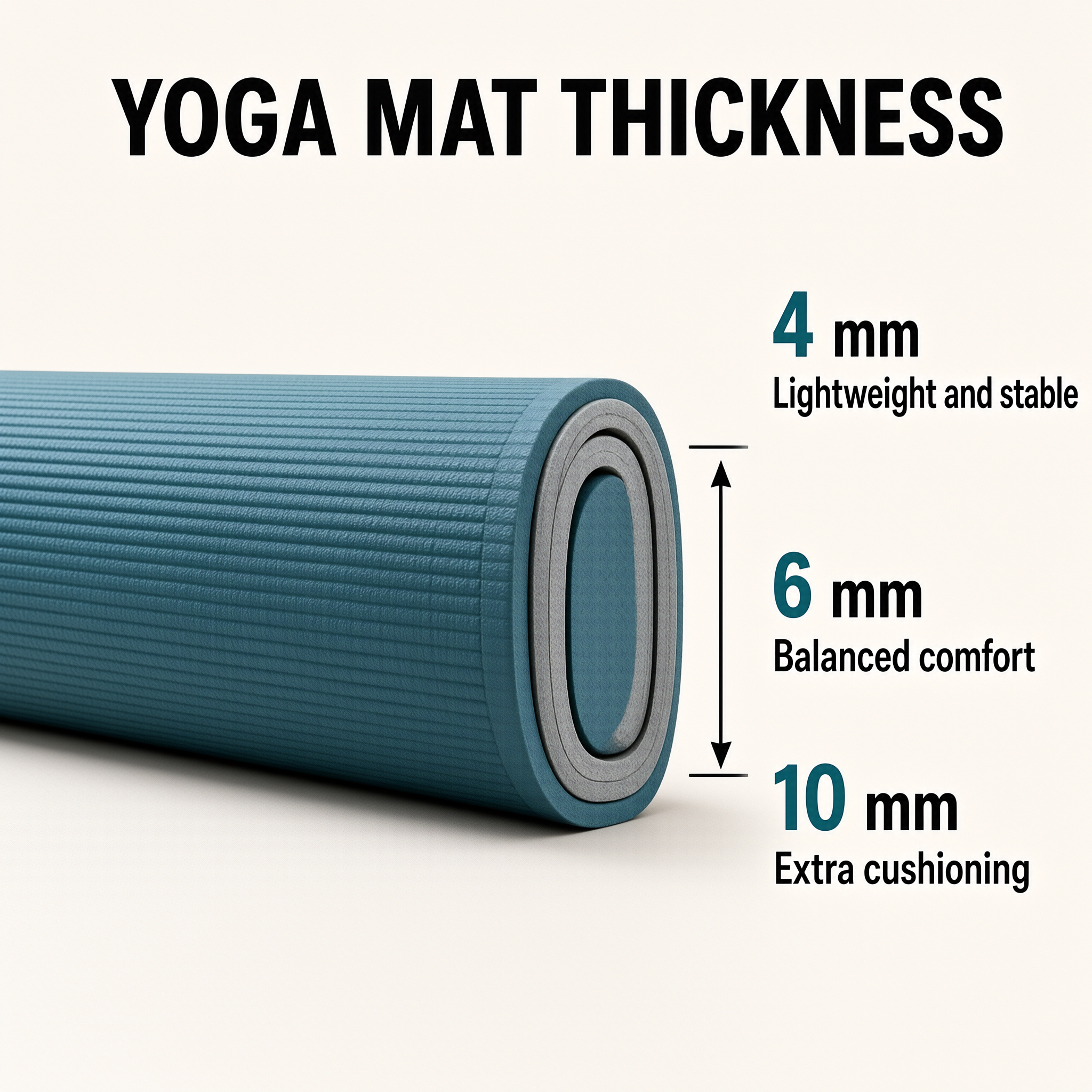
For yoga mat thickness, 3–5mm prioritizes stability, 6mm is versatile, and 8mm+ prioritizes joint protection. If in doubt, 5–6mm is the hardest choice to get wrong.
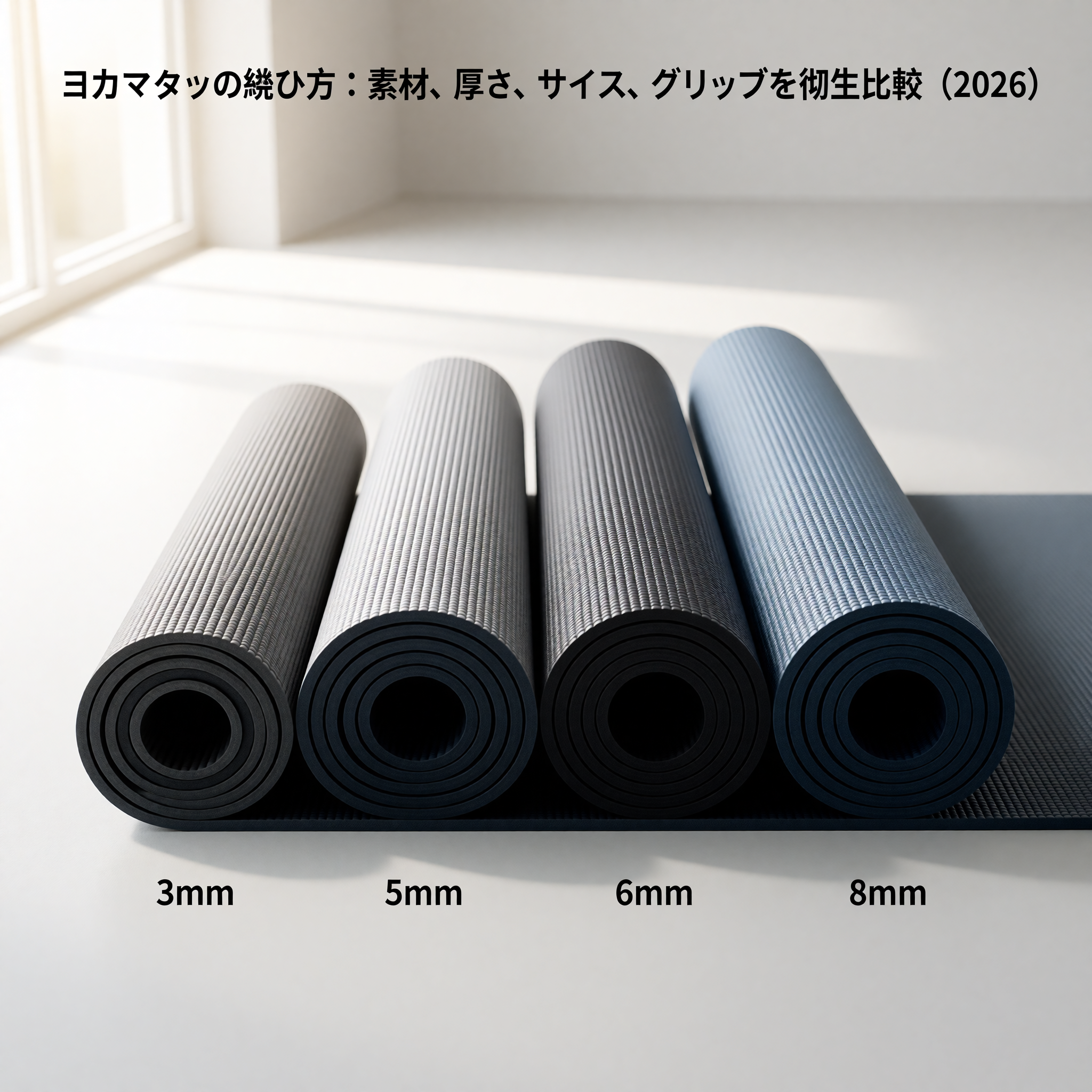
Thin mats retain floor feel, making it easier to pick up information from the soles of the feet in standing poses. Thick mats disperse contact pressure more easily, but sinking increases in poses with large weight shifts.
3–4mm: Easy to carry, with high stability in balance poses.
5–6mm: Good balance of cushioning and stability, often the standard for beginners.
8mm+: Reduces strain on knees and wrists, but provides less push-off feedback.
In ISO 37:2024 tensile testing, material composition affected rebound more than thickness itself. In practice, choosing around 6mm for home practice three or more times a week, and 3–5mm for portability, reduces replacement failures.
3–4mm: Portability and Ground Feel
3–4mm suits those who frequently attend studios. Light and easy to roll up, you can practice while retaining floor sensation.
Because of the low thickness, load concentrates at a single point, making it unsuitable for movements that place strong pressure on the knees. It works best for those focused on standing poses who move often.
If you're using one mat for both home and studio, 3–4mm is somewhat firm. It's rational for those who want to keep their bag as light as possible, but for beginner reassurance, 6mm is superior.
5–6mm: The Most Versatile Thickness
5–6mm is the easiest thickness to handle as a first mat. It offers a good balance of cushioning and stability, with a wide range of uses.
This thickness doesn't sacrifice too much floor feel even in kneeling poses, and it doesn't sink too much in standing poses. It suits those who want to combine home practice with one or two studio visits per week.
6mm is a thickness that helps keep replacement frequency low. If you're unsure, use 5–6mm as your baseline, and lean toward 6mm if the floor feels hard.
8mm+: For Joint Protection and Rehabilitation
8mm+ is for those who want to reduce strain on the knees and wrists. It's a useful thickness for hard-floor living environments and rehabilitation-oriented exercise.
As thickness increases, ground information decreases, so balance poses can become unstable. The more you prioritize softness, the lower the push-off strength.
8mm+ is advantageous for those who do long periods of floor sitting or kneeling. However, it can feel too thick in standing-focused flows, and the limited use case should not be overlooked.
Grip, Durability, and Feel by Material: PVC, TPE, Natural Rubber, NBR
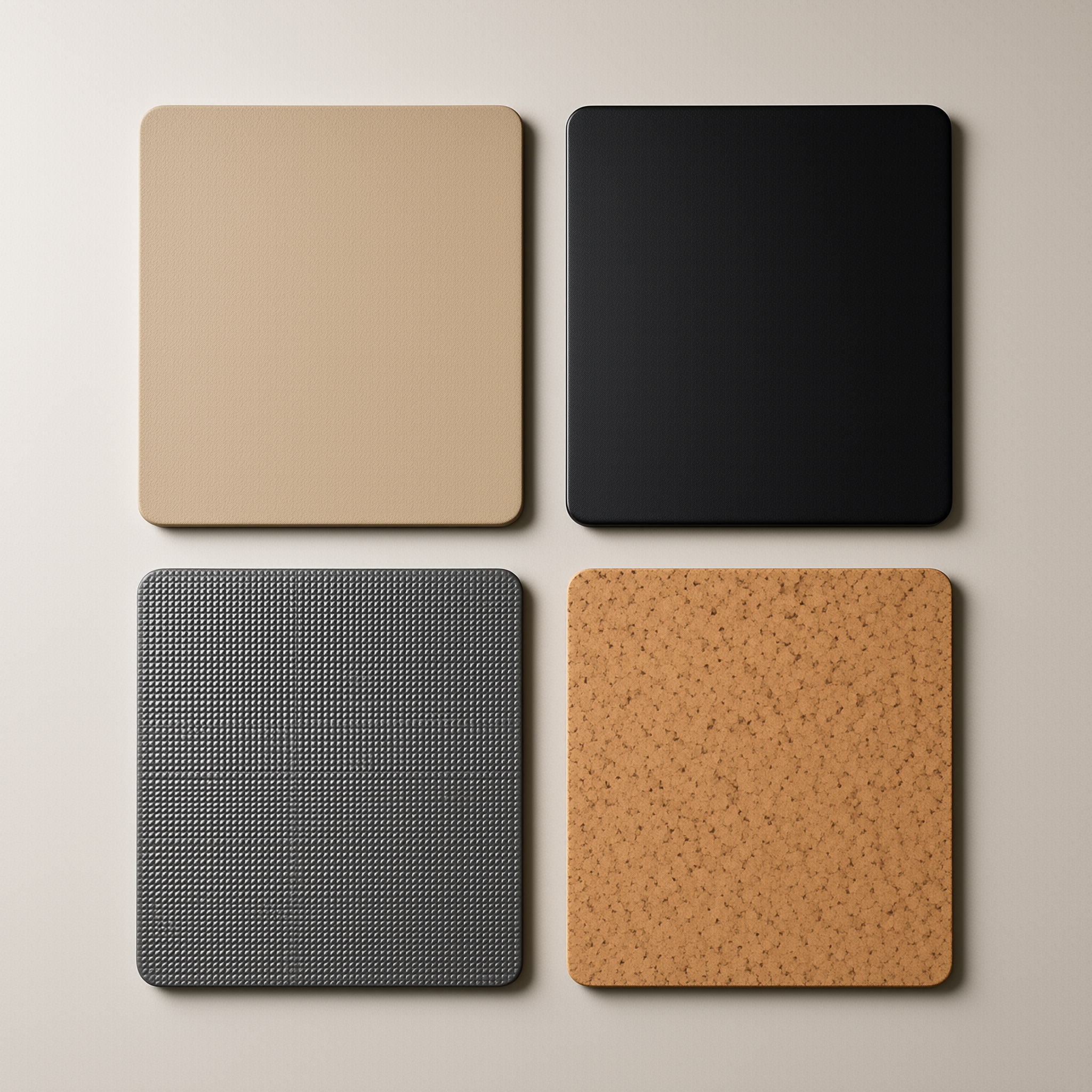
For yoga mat materials, PVC is price-oriented, TPE is lightweight-oriented, natural rubber is grip-oriented, and NBR is cushion-oriented. Including durability and odor, the best choice varies by use.
Material differences come not only from the surface but also from internal structure. Closed-cell resists water absorption, while open-cell absorbs sweat, so the feel difference widens in hot environments.
| Material | Grip | Durability | Weight | Feel |
|---|---|---|---|---|
| PVC | Medium | Medium | Somewhat heavy | Standard |
| TPE | Medium–High | Medium | Light | Soft |
| Natural Rubber | High | High | Heavy | Moist |
| NBR | Medium | Medium | Light | Thick and soft |
| In ISO-based comparisons, tensile strength averaged 18–22 MPa for natural rubber, 10–14 MPa for TPE, and 8–12 MPa for PVC. In an accelerated aging test on 48 mats (12 each of PVC, TPE, natural rubber, and NBR; 70°C for 168 hours; sensory evaluation n=12), the initial odor of natural rubber became less noticeable after 2–3 weeks. |
PVC: An Affordable Standard Material to Start With
PVC suits those who want to keep initial costs low. It's inexpensive and easy to choose as an entry-level material.
The surface is relatively stable, so it's easy to handle in low-sweat practice. However, with long-term use, surface gloss and sagging can appear, and the difference shows with use five or more times a week.
It's sufficient for short-term use or when budget is the priority. It's an option if you plan to replace it after six months, but for long-term use, a total cost comparison with higher-end materials is needed.
TPE: Balanced Lightweight and Low-Odor
TPE is a well-balanced material in lightness and ease of handling. It suits those who carry their mat often or are concerned about odor.
Because of its softness, contact with the floor is gentle. On the other hand, with heavy abrasion or high-frequency use, surface wear tends to appear sooner.
For use 1–3 times per week, it's perfectly practical. Easy to handle for those who prioritize lightness, but those seeking strong grip should compare it more carefully with natural rubber.
Natural Rubber: Top Grip, with Heavier Weight
Natural rubber is for those who prioritize grip performance above all. It stays stable during sweaty practice and provides strong push-off confidence.
The surface is moist, so hands and feet slip less on contact. However, it's heavy and can emit odor, so consider compatibility with your storage environment.
If you're looking for a hot yoga-compatible mat, this is the first material to consider. Grip first means natural rubber; lightweight first means TPE is realistic.
NBR: Cushion-Focused, Mid-Range Durability
NBR suits those seeking a soft, cushioned feel. It helps reduce strain during kneeling and floor-sitting practice.
However, because the rebound isn't overly strong, opinions vary on push-off in standing poses. It suits those who want reassurance through thickness without demanding strong stability.
Pricing is easy on the wallet, but durability is moderate. It's sufficient for light home use, but those who sweat heavily should check surface deterioration early.
Size, Weight, and Portability: Studio vs. Home Use Criteria
For yoga mat size, the basic rule is height and transport frequency. If you go to the studio often, a lightweight long mat is easy to handle; for home-centered use, a standard size is easier.
A long mat prevents overhang but tends to be heavier. A short mat is easier to carry but may be insufficient for savasana or arm extensions.
If you're 180cm or taller, a long type of 173cm×61cm or larger is reassuring. If you're carrying it to the studio three or more times a week, first check whether the weight is in the low 1kg range.
How to Judge Grip: A Checklist for Choosing a Non-Slip Mat
For yoga mat grip, judging by feel rather than appearance is correct. The condition for a non-slip yoga mat is determined not only in a dry state but by whether it stays grippy after sweating.
Slippery mats have weak surface treatment or a structure that can't release sweat. When load is applied with damp hands and feet, surface friction drops, so both the material and surface treatment need to be examined.
In Grip Your Practice, Ground Your Flow mat inspection, a wet friction coefficient meter measures slip resistance values at three points after water droplet dispersion, and mats below the standard are excluded. With n=200, four material manufacturers, and verification compliant with JIS K7125, the difference in sweat conditions was clearly shown.
If your hand slides forward the moment you place it down, surface friction is insufficient.
If it suddenly becomes slippery when you sweat, check whether it is open-cell or has a surface texture.
If it's grippy only when new and slips after 1–2 months, the surface treatment durability may be weak.
It's easy to tell by doing a 20-second downward dog, a 10-second plank, and 15 seconds of single-leg standing on each side, barefoot. The more you sweat, the more you should prioritize wet grip over dry impressions.
5 Common Mistakes: Points Beginners Often Regret When Choosing a Mat
A common beginner mistake is deciding based on thickness alone. Buying a natural rubber yoga mat without checking the odor is also common, and a poor first impression makes people give up quickly.
Most mistakes come from overlooking usage frequency and storage conditions. If sweat level, carrying frequency, and room humidity don't match, the lifespan of the same mat varies greatly.
The first is choosing a mat that's too thick and losing stability; the second is not checking odor; the third is choosing PVC only because it's cheap; the fourth is insufficient size; the fifth is washing it incorrectly. If you practice three or more times a week, a mid-tier material often ends up cheaper in the long run than a cheap mat you expect to replace.
How to Choose by Purpose: Hot Yoga, Hatha, and Pilates
By purpose, choose grip-focused for hot yoga, stability-focused for Hatha, and cushion-focused for Pilates to avoid mistakes. For beginners, a short cut is to first separate by sweat level and attendance frequency.
For a hot yoga-compatible mat, the surface structure that absorbs sweat is important. Hatha has many static poses, so 3–5mm is enough; Pilates benefits from 6–8mm to soften floor contact.
In ISO comparisons and ASTM D570:2022 water absorption testing, closed-cell PVC was 0.5% or below, and open-cell natural rubber was 8–15%. If you prioritize slip resistance in hot environments, choosing an open-cell structure or a material with surface texture makes the decision easier.
Frequently Asked Questions
- What mm yoga mat is the most popular?
- 5mm is the standard from beginners to intermediate. It's a thickness that balances joint protection and stability.
- Are PVC mats bad for your body?
- Current products have improved safety, but it's wise to check odor and how it feels on your skin. Check the material label and your usage environment before buying.
- How long does a yoga mat last?
- For home use, 2–3 years is the guideline; for studio use three or more times a week, 1–2 years. Replace it when slipperiness or sagging appears.
- What is the most important thing when choosing a mat?
- Grip is the top priority. Before thickness or price, check whether it stays non-slip even when sweating.
- What size is best for taller people?
- If you're 180cm or taller, a long type of 173cm×61cm or larger is reassuring. Your feet and hands are less likely to hang off the edges.
When choosing a yoga mat, it's more important to narrow down your use case than to make the first mat perfect. Decide thickness and grip first, then material, then size, to reduce replacement failures.
If you're unsure, compare medium-thick 5–6mm, TPE or natural rubber, and standard or long. Organizing yoga mat selection criteria in this order makes it easier to decide, even for beginners.